
technical
What Happens After Planning Permission?
project
Planning Note
date
29.06.2026
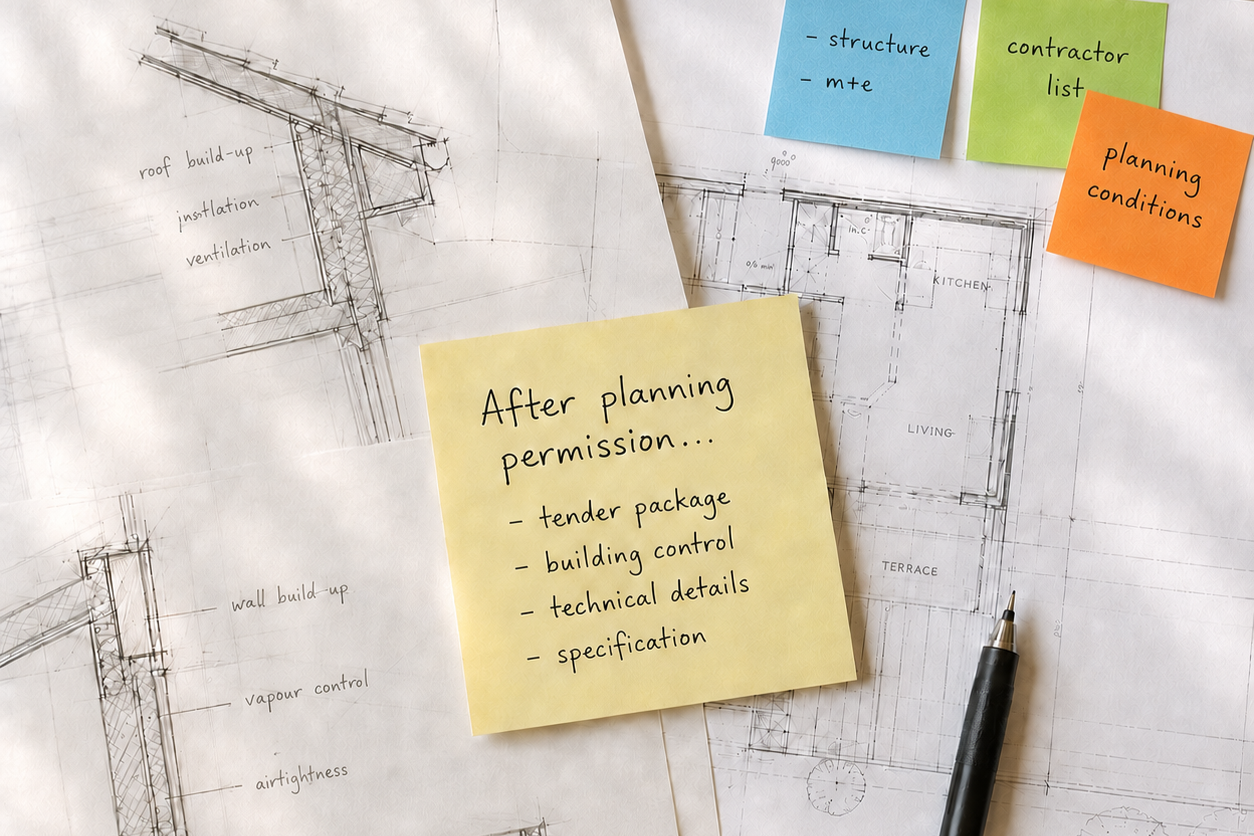
What Happens After Planning Permission?
Receiving planning permission is an important step, but it is not the end of the design process.
Planning is mainly concerned with whether the proposal is acceptable in principle: how it looks, its scale, material choices, how it relates to neighbouring properties, its use, and how it sits within its surroundings. It does not explain in full detail how the project will be built.
After planning permission has been granted, the next stage is normally to develop the technical information needed for Building Regulations, pricing and construction.
This stage looks more closely at how the building will actually work. It includes structure, drainage, ventilation, fire safety, waterproofing, construction details, materials, windows, doors, roof build-ups and how new work connects to the existing building.
For many home projects, a structural engineer will also be needed. They may design steel beams, foundations, roof structure, retaining walls or other structural elements, depending on the project. Their information then needs to be coordinated with the architectural drawings.
Building Regulations are separate from planning permission. A project can have planning approval, but it will still need further technical design before it can be submitted to Building Control and before a builder can properly price or build it.
At this stage, it is also sensible to think carefully about the level of information needed for tender. If builders are asked to price from limited information, there may be more assumptions, exclusions and uncertainty. A clearer package of drawings, schedules and specifications can help builders price the same information, making their quotes easier to compare and more reliable.
The exact amount of information needed will depend on the size and complexity of the project. A small internal alteration may only need a limited package, while a larger extension, older building, listed property or more complex refurbishment will generally need a more detailed set of drawings, specification and consultant information.
This stage can sometimes feel less exciting than the earlier design work, but it is an important part of turning the planning design into something that can be built properly.
It is also the point where many practical decisions are made. These might include window and door choices, rooflights, insulation approach, heating and ventilation, drainage routes, floor finishes, lighting, sanitaryware, ironmongery and other items that affect the final cost and quality of the project.
For projects in Cambridge and the surrounding villages, this stage can be particularly important where older buildings, conservation areas, neighbouring properties or existing site constraints need to be carefully coordinated.
Once the technical information is developed, the project can usually move towards a Building Regulations application, tendering to builders, or both. For some projects, these stages happen in parallel, but it is important that the information is clear enough for the decisions being made.
If you have recently received planning permission, or are unsure what information is needed next, it is helpful to review the approved drawings, planning conditions, Building Regulations requirements and any consultant input needed before approaching builders.
This helps avoid the project moving too quickly from planning approval into construction without enough information in place.
If you are thinking about extending or altering your home, you are welcome to get in touch.
Please include the property address, a few photographs, any existing drawings if you have them, and a short description of what you would like to do.
You can contact lvp architects through the form on our Us page.