
planning
Planning a Home Extension
project
Planning Note
date
19.06.2026
Planning a Home Extension
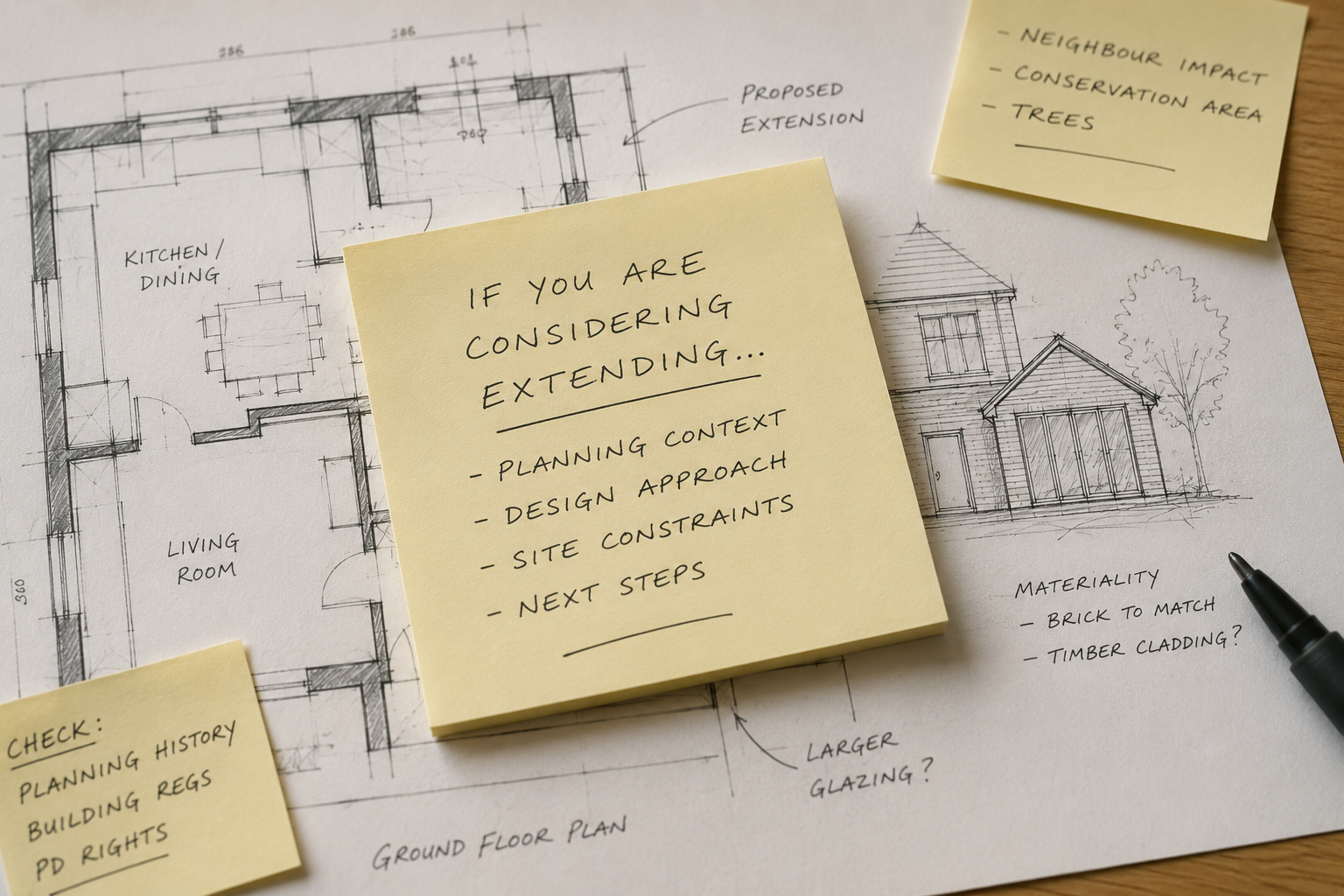
If you are thinking about extending your home, one of the first questions is usually whether planning permission is needed.
The answer depends on the property, its location, previous alterations, the size of the proposed extension, and whether the house is listed, in a conservation area, or subject to other planning restrictions.
Some smaller extensions may fall under permitted development, but this still needs to be checked carefully. Conservation areas can restrict what is allowed, and listed buildings may require Listed Building Consent even where planning permission is not needed. In many cases, it is sensible to obtain a Lawful Development Certificate, so there is a formal record that the work was lawful at the time it was carried out. This can also be useful if the property is sold in the future.
For projects in Cambridge and the surrounding villages, the planning context can vary quite a lot, given its historic evolution and areas of importance. A modest change to one house may be straightforward, while a similar change to another property may need a more careful approach because of neighbouring building heights, conservation area character, protected trees, overlooking, or the design of the existing house.
At the start of a project, we normally begin by looking at the existing property, the planning history, the site constraints and what the client is hoping to achieve. Sometimes the best answer is not simply to add more space, but to rework the existing layout so the house functions better.
This early stage can be very useful. It helps test what may be realistic before too much time or money is spent developing a full proposal.
If planning permission is needed, the application will usually include existing and proposed drawings, together with supporting information where required. Depending on the project and its location, this might include a Design and Access Statement, heritage statement, tree report, ecology information or other reports requested by the local authority. The simplicity or complexity of an application always depends on the location and its constraints.
For most householder applications, the decision period is usually around 8 weeks once the application has been validated, although this can sometimes be extended depending on the council, consultees and the nature of the proposal.
Planning is only one part of the process - the “how it looks and sits in its environment” stage. Even if planning permission is granted, the project will still need Building Regulations information before it can be built. This is the more technical stage, dealing with structure, insulation, ventilation, drainage, fire safety and other construction requirements - the “how it is built” stage.
If you are thinking about extending or altering your home, you are welcome to get in touch.
Please include the property address, a few photographs, any existing drawings if you have them, and a short description of what you would like to do.
You can contact lvp architects through the form on our Us page.